
Specimens of Note
A curated selection of exceptional mineral specimens — chosen for their rarity, aesthetic distinction, and the stories they carry.
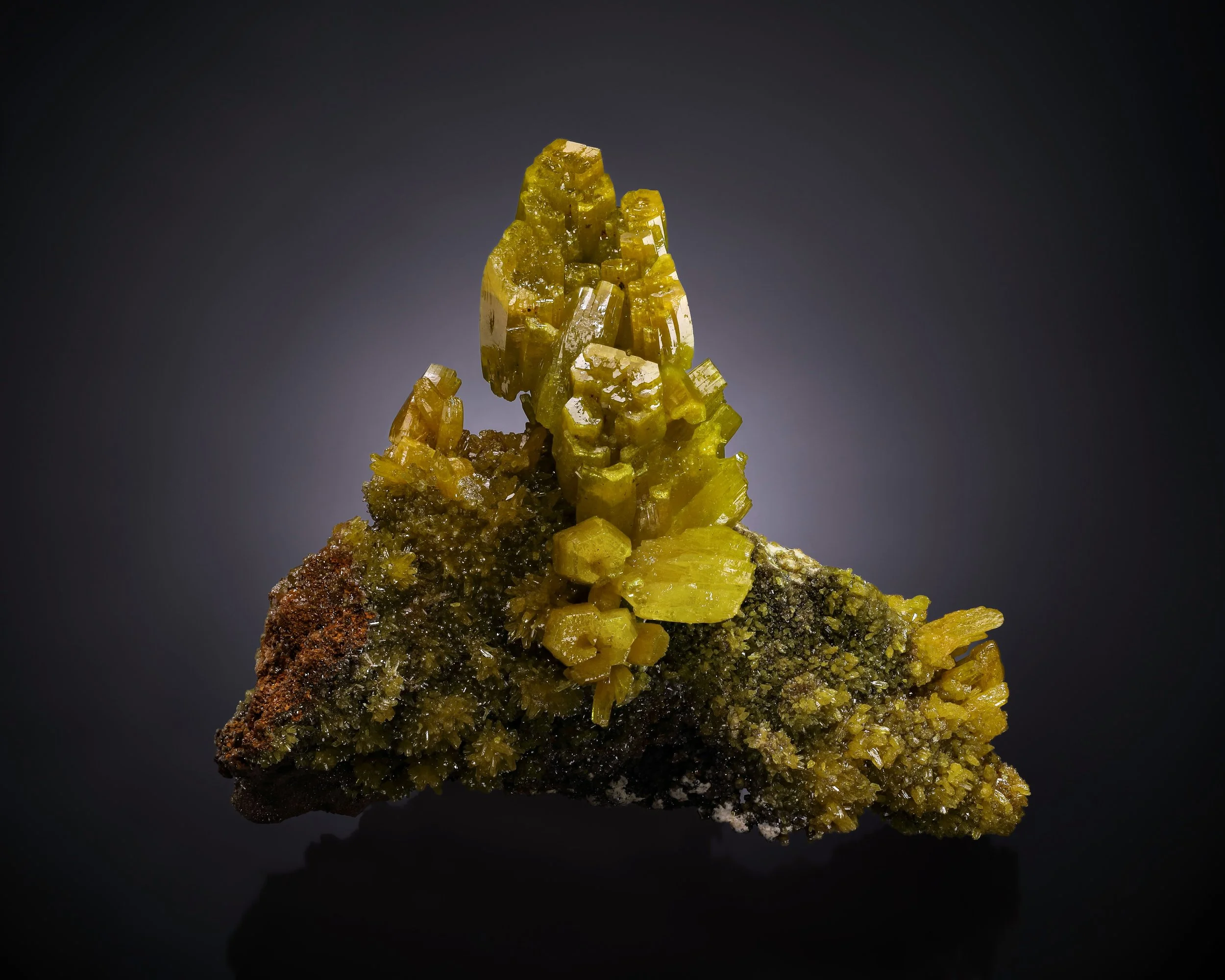
Pyromorphite
The finest material from this locality is often characterized by dense masses of well-spaced crystals with excellent color and luster. While these specimens can be exceptional in quality, they often share a similar visual language, resulting in a certain aesthetic fungibility. This piece is entirely different. From a small, delicate foundation of fine pyromorphite crystals, a massive central cluster rises dramatically from the matrix, creating an extraordinary sense of scale and movement..
The crystals possess a beautiful yellow color, while the surfaces carry a wet, almost liquid luster punctuated by a subtle metallic quality that speaks to the lead-rich chemistry of this remarkable mineral. The juxtaposition between the minute crystals at the base and the imposing cluster above is seldom encountered from Bunker Hill and gives the specimen an unmistakable identity that is immediately memorable.
The principal cluster is composed of hoppered crystals whose intricate, stepped geometry creates a striking fractal-like appearance, producing an almost organic sense of growth and structure. For its combination of saturated color, exceptional luster, hoppered morphology, and especially its dramatic and highly unusual presentation, this Bunker Hill pyromorphite is a singular and memorable composition that stands apart from its peers.
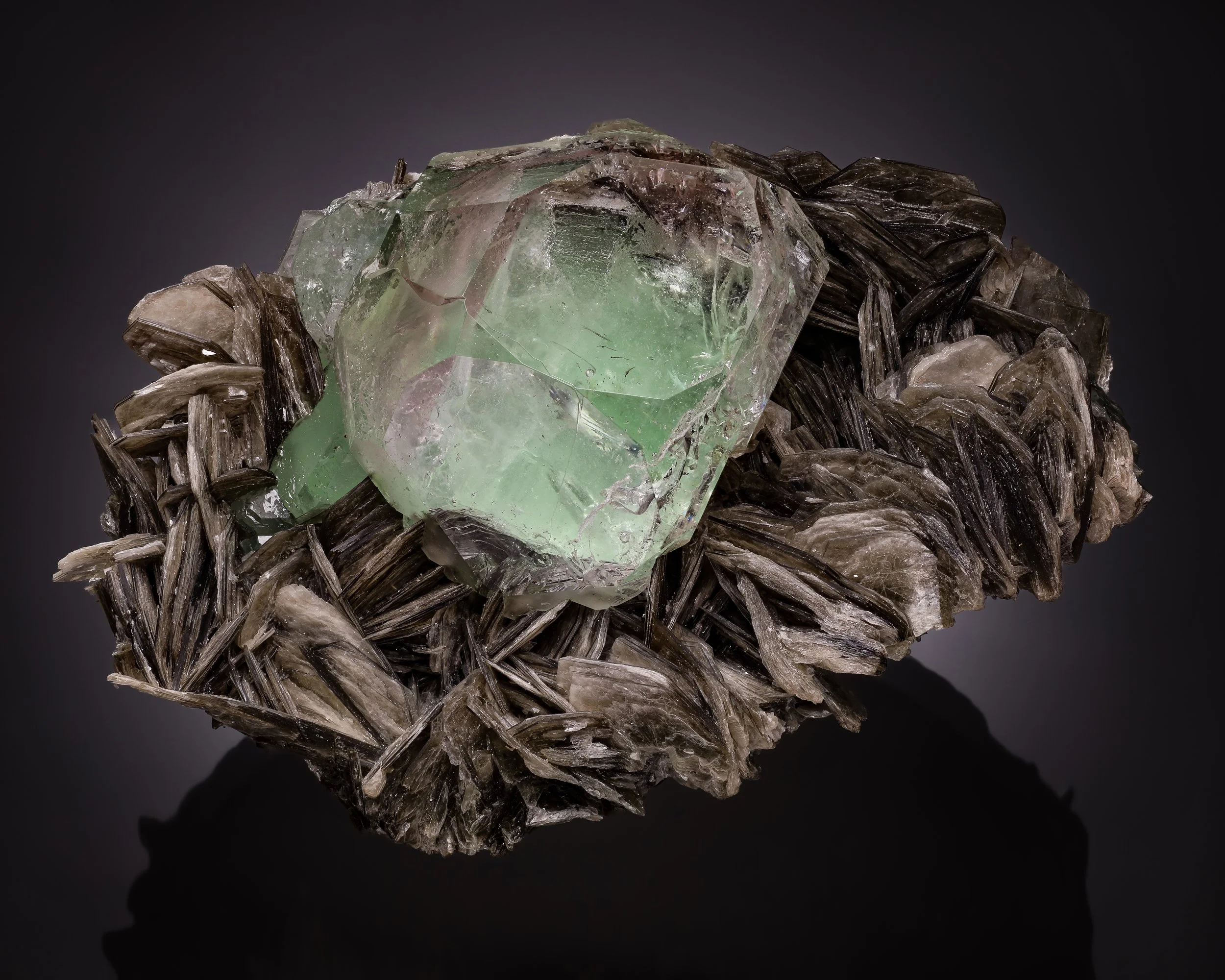
Spinel Twin Fluorite on Muscovite
The pegmatites of the remote Nagar region of northern Pakistan are renowned for producing world-class aquamarine, apatite, quartz, and, on rare occasion, fluorite. Among these already uncommon fluorites, spinel-law twins of this caliber represent one of the most unusual and sought-after expressions of the species. Hexagonal faces are interwoven through spinel-law twinning, creating an intricate geometric form that resembles a geodesic dome more than a conventional fluorite crystal. It is a captivating habit that reflects the high-temperature conditions under which pegmatitic fluorite crystallized.
The surfaces exhibit a superb, wet luster with no evidence of the etching or degradation so commonly encountered in pegmatitic fluorites. The color is a kiwi-green, complemented by a subtle pink growth zone that reveals itself only as the specimen is rotated, rewarding careful examination with an unexpected flash of color. The crystal is perfectly positioned atop a balanced muscovite matrix, giving the specimen a natural elegance rarely seen in this habit.
While spinel-law twinned fluorites commonly occur as intergrown, chaotic aggregates with rounded or indistinct silhouettes, this example possesses crisp geometry, sharp definition, and an exceptional matrix-to-crystal ratio. Combining an exceedingly rare crystal habit, pristine luster, subtle zoning, and an unusually balanced composition, this specimen represents one of the finest aesthetic expressions of pegmatitic fluorite from Chumar Bakhoor.
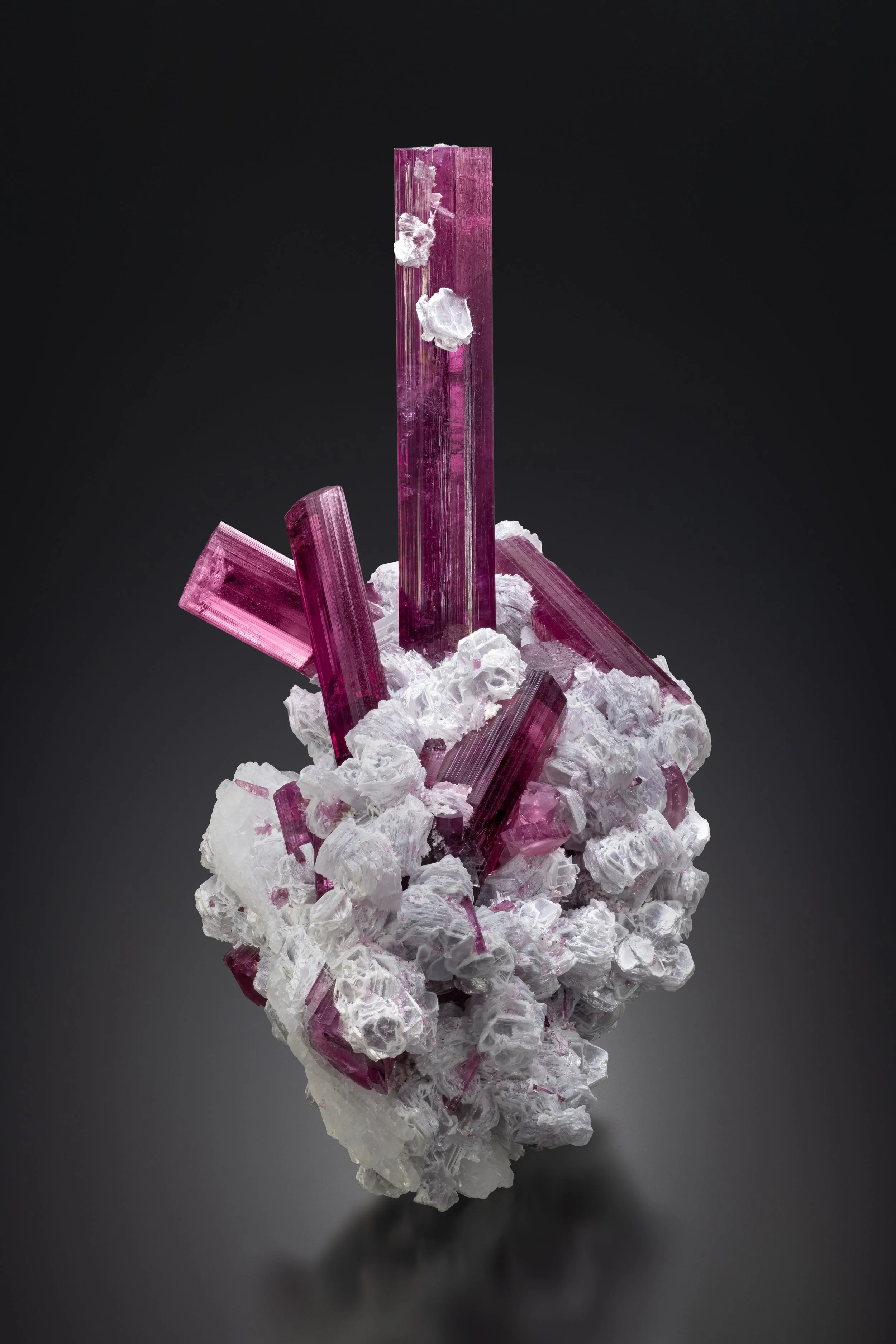
Tourmaline with Lepidolite
Among the great pegmatite discoveries of the twentieth century, few localities have achieved the legendary status of Brazil's Jonas Mine. Discovered in 1970, the pocket produced an extraordinary cache of world-class rubellite tourmaline, yielding both magnificent mineral specimens and exceptional gem rough. While the original discovery was prolific, locating a truly refined Jonas Mine specimen on today's market has become exceedingly difficult. Decades of absorption into important private collections have left comparatively few exceptional examples available, particularly those that combine aesthetic composition with excellent condition.
This specimen exemplifies the qualities that have made the locality so revered. A prominent rubellite crystal rises from the center of a richly textured lepidolite matrix. The crystal displays a beautiful raspberry-pink hue with outstanding luster, while numerous smaller tourmaline crystals of gem quality surround the focal crystal, adding depth and visual interest without distracting the viewer.
Equally noteworthy is the specimen's state of preservation. Matrix tourmalines are notoriously prone to restoration or repair, this specimen, however, remains entirely free of restoration or repair—an increasingly uncommon distinction that significantly enhances both its rarity and desirability. Combining the historical significance of the Jonas Mine with exceptional aesthetics, gem-quality crystals, pristine condition, and an unusually refined composition, this specimen represents the enduring appeal of one of the most celebrated tourmaline discoveries ever made.
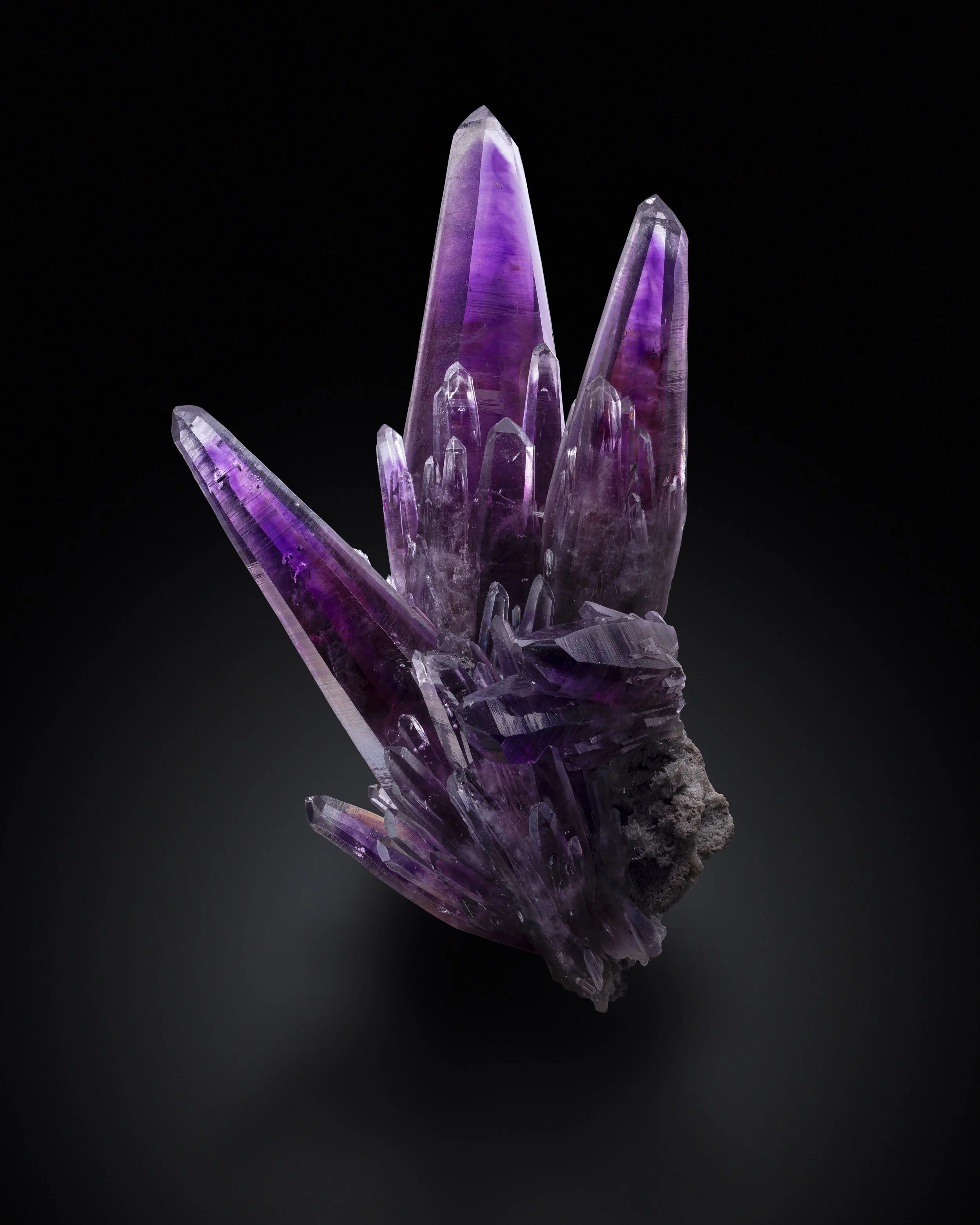
Amethyst on Quartz
Among the world's finest amethysts, the celebrated specimens from Guerrero, Mexico are instantly recognizable for their distinctive style of crystal growth. Mined during the mid-1980s, this specimen embodies the defining characteristics that established the locality's reputation. Large, sharply terminated amethyst crystals serve as the foundation for generations of smaller crystals that rise from their faces, creating an architectural, cathedral-like appearance unlike amethyst from any other locality. It is this dramatic interplay between primary and secondary growth that has made Guerrero amethyst one of the most coveted varieties of the species.
A prominent cluster of large amethyst crystals forms the centerpiece, with just the right amount of spacing to create a composition that feels balanced and refined. The crystals display a richly saturated grape-purple color that glows brilliantly when backlit. Their sharply pointed, tessin-like habit adds an additional layer of elegance.
Unlike the majority of Guerrero specimens, which occur as crystal clusters, this example is preserved on its original matrix. The specimen remains in pristine condition, with exceptional luster and outstanding crystal definition throughout. Combining classic Guerrero morphology, superb color, original matrix, and impeccable preservation, this is a textbook example from one of the most celebrated amethyst discoveries ever made.
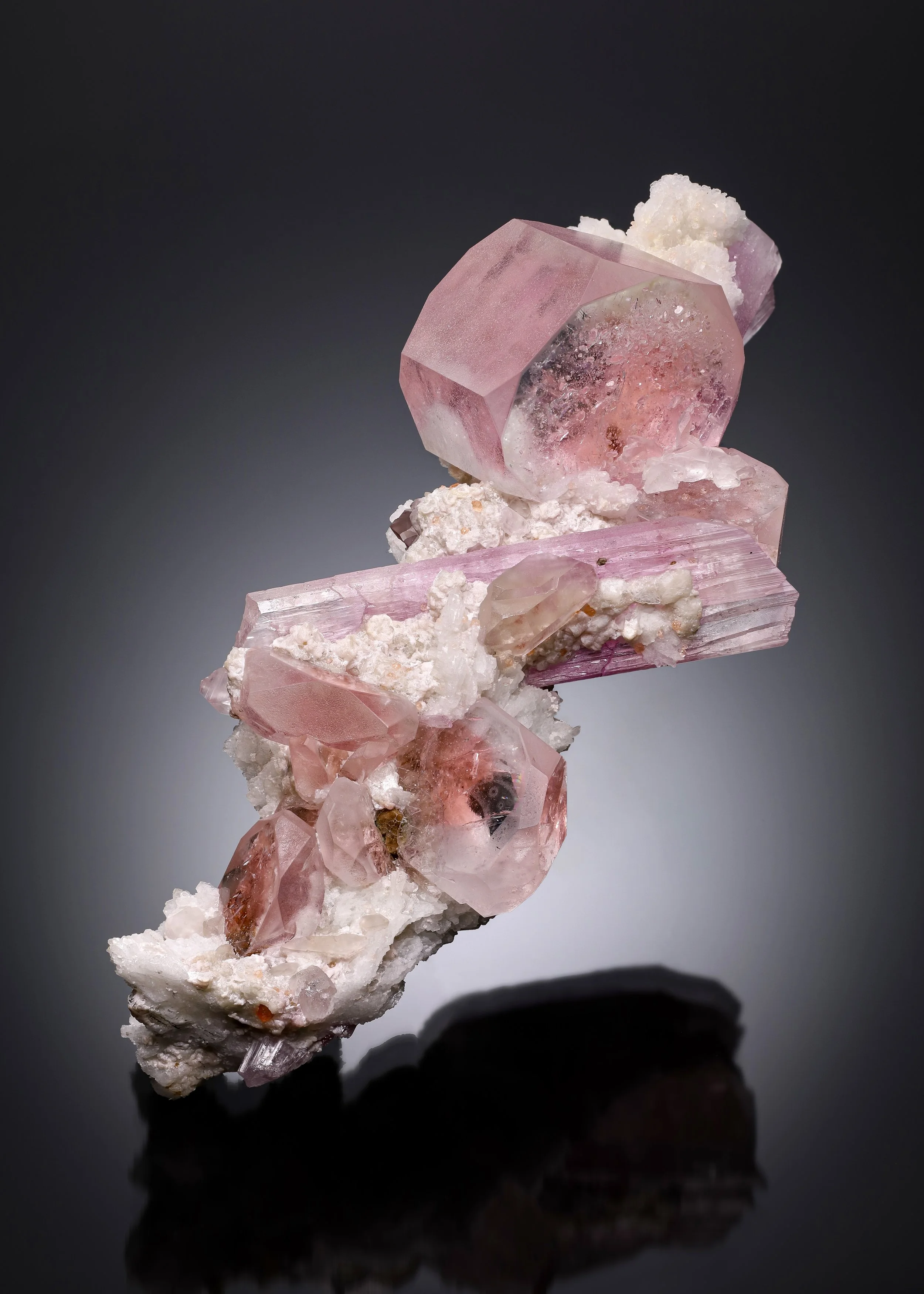
Morganite with Kunzite, Quartz and Albite
Known affectionately among collectors as the "Candystick," this specimen stands as one of the most iconic and recognizable morganites ever recovered. The specimen is defined by a single, beautifully isolated morganite crystal with exceptional clarity and a vivid hot-pink color. Perfectly positioned beneath the morganite is a sharply terminated kunzite crystal, creating a visual dialogue between the two minerals and giving rise to the specimen's celebrated "Candystick" appearance.
Numerous additional morganite crystals emerge throughout the matrix, accompanying them are quartz crystals, white albite, and scattered orange spessartine garnets that provide vibrant accents throughout the composition. Together, these minerals create what can only be described as a pegmatite bouquet, a rich and colorful assemblage showcasing the extraordinary diversity of the Mawi pegmatite..
Equally remarkable is the specimen's state of preservation. Despite its complexity and fragile architecture, the piece survives in pristine condition, free from damage, contacts, or compromise, and remains entirely unrestored and unrepaired—a rarity among large and delicate pegmatite specimens where restoration is often unavoidable. Combining world-class morganite, perfectly placed kunzite, exceptional color zoning, and a rich suite of associated minerals, the Candystick occupies a special place in the history of mineral collecting.
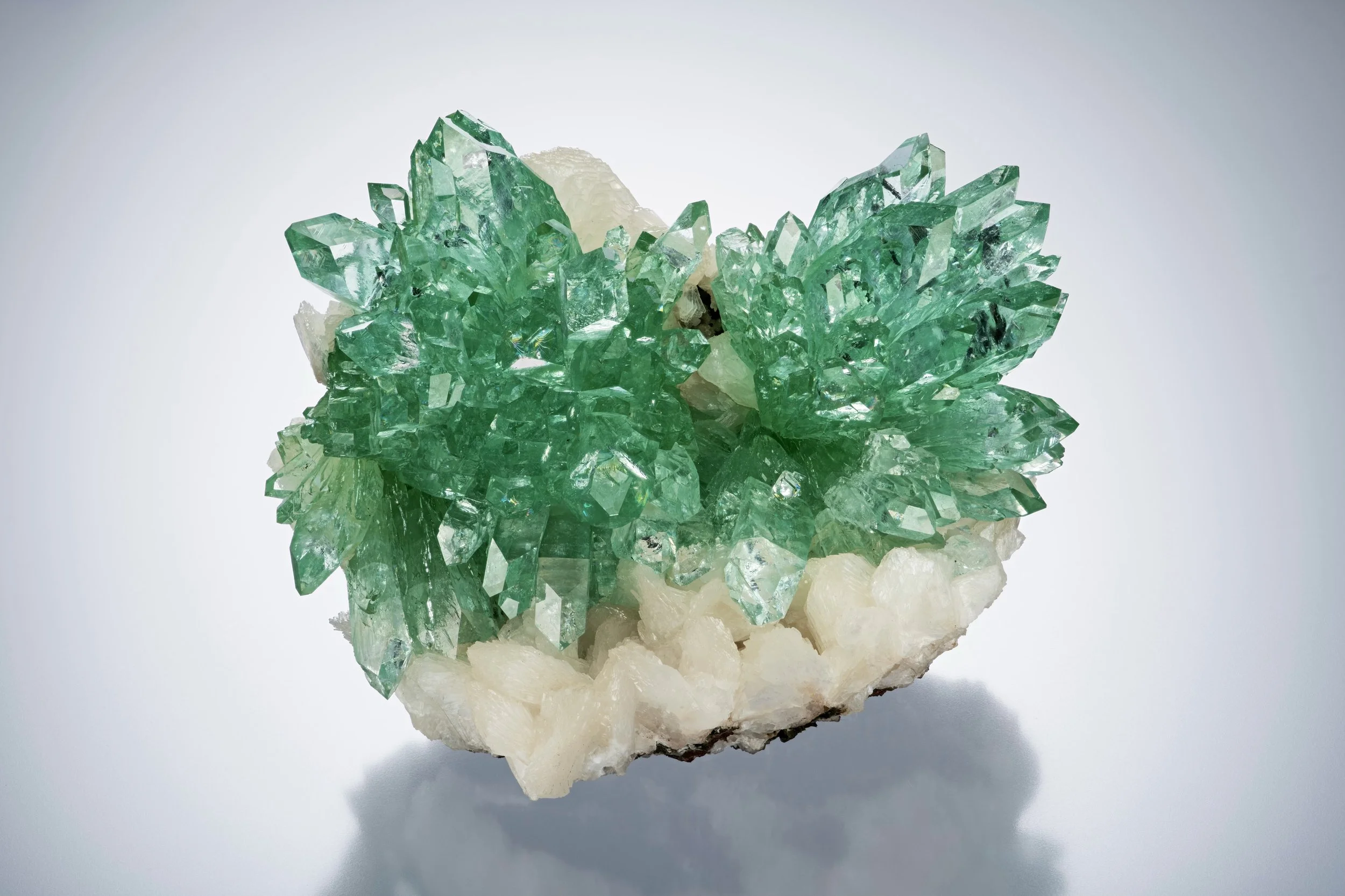
Apophyllite on Stilbite
The Deccan Traps are among the world’s most prolific sources of zeolites, having produced an extraordinary quantity of material over decades of mining. Yet the sheer abundance of material can obscure just how uncommon truly exceptional specimens are. Only an exceedingly small fraction possess the combination of crystal perfection, saturation, luster, and aesthetic composition seen here.
The specimen features two extraordinary clusters of apophyllite crystals, each arranged in a remarkable formation that evokes the delicate geometry of a lotus flower, giving the specimen an almost botanical quality despite its entirely mineralogical origin. The crystals possess a saturated, phosphophyllite-like green color.
The surfaces are clean and reflective, giving each crystal a sense of depth and luminosity rarely encountered in apophyllite. This is an apophyllite that transcends the typical material associated with the Deccan Traps. It represents the rare intersection of mineral perfection and natural aesthetics—precisely what makes a great mineral specimen memorable.
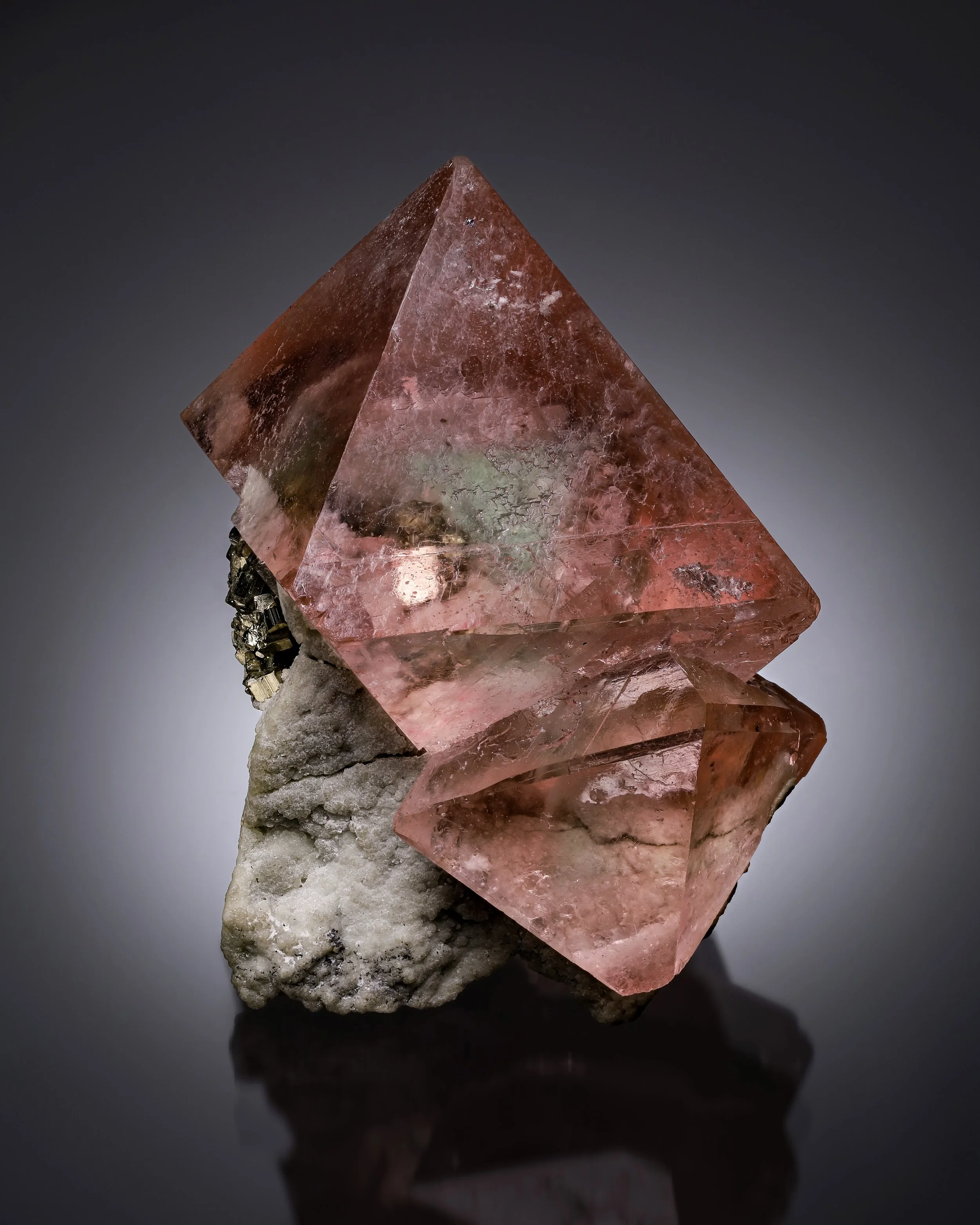
Fluorite with Pyrite
A truly exceptional example of the coveted pink octahedral fluorites discovered in Peru in 1980. These fluorites were initially brought to market by legendary mineral dealer Rock Currier, and this specimen remained in his personal collection for decades before being sold in 2019 at auction with the rest of his collection.
Its presentation is virtually everything one could ask for: elegant orientation, superb crystal quality, and an aesthetic balance that makes the specimen immediately compelling.What makes this discovery recognizable is the internal zoning within the pink fluorite, where luminous green cores glow from deep inside the crystal. This specimen displays that defining characteristic exceptionally well.
Adding further interest is an association of pyrite, including a fine cubic crystal included within the fluorite itself. The juxtaposition of sharply defined metallic pyrite and translucent, zoned fluorite adds depth and complexity, offering a glimpse into the mineral's formation. For its combination of orientation, luster, internal zoning, association, and provenance, this is, without question, the most refined Peruvian pink fluorite I have handled.
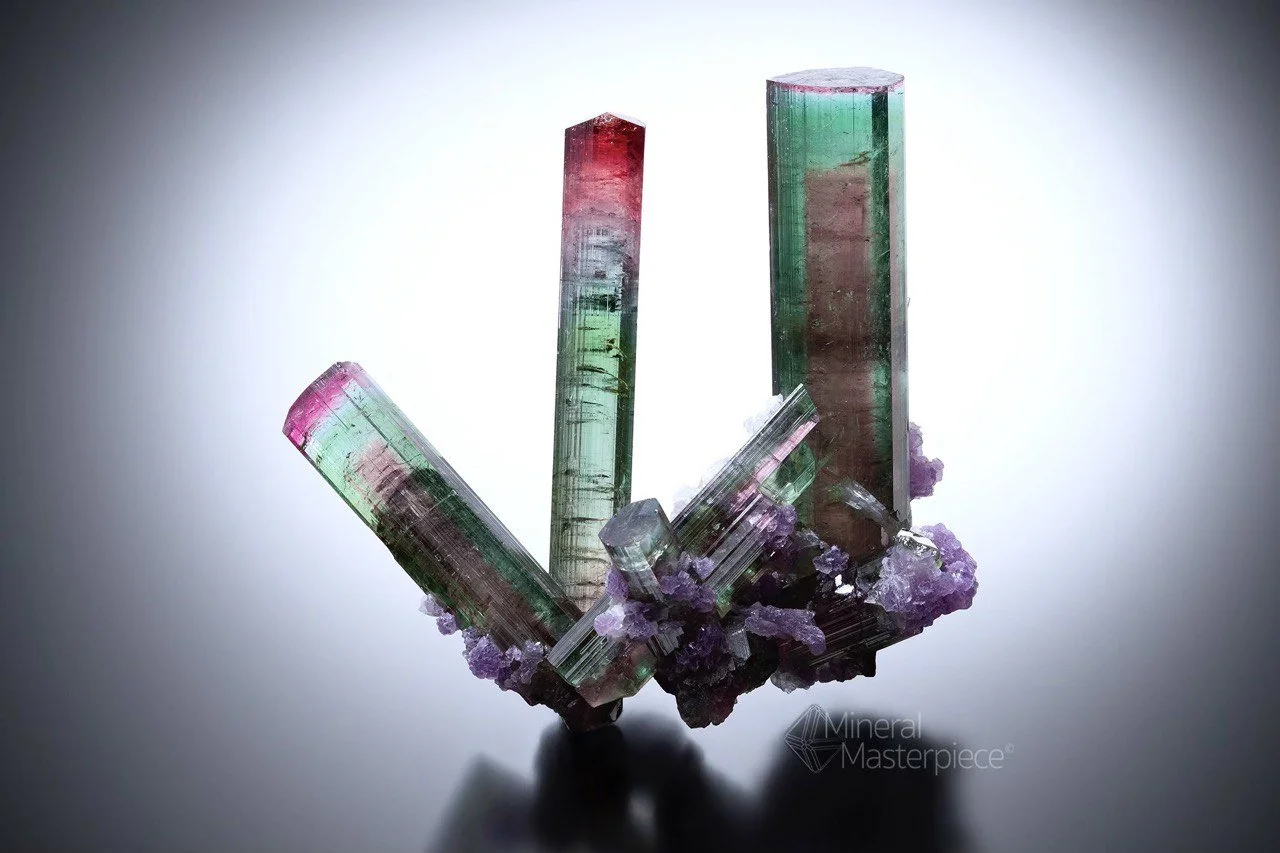
Tourmaline on Lepidolite
Since the celebrated discoveries at the Pederneira Mine in the 2000s, no modern tourmaline find has generated as much excitement as the "Lollipop Pocket," discovered in 2020. The pocket quickly became famous for its unmistakable color zoning where the terminations display a vivid cherry-red cap that emerges from soft pastel transitions.
Three prominent tourmaline crystals rise from the matrix in a beautifully balanced arrangement, creating an elegant trident-like composition. The central crystal displays the iconic cherry-red termination that defines the pocket, while the two flanking crystals terminate with the characteristic thin pink caps. Together, they frame one another perfectly, highlighting the complete range of zoning that has made this discovery so celebrated.
At the base of the specimen, lavender lepidolite provides a soft, complementary foundation that enhances the pastel tones of the tourmalines while allowing the saturated cherry-red termination to command the viewer's attention. The color contrast between the tourmaline and the lepidolite matrix is both striking and harmonious and commands the viewer's attention. This specimen belongs among the finest examples, with exceptionally glassy surfaces and gem-clean sections that give the crystals remarkable brilliance. The result is a specimen that captures the essence of the Lollipop Pocket at its very best.
.jpg?format=2500w)
Fluorite
In August 2019 before the COVID-19 pandemic effectively closed China to the outside world, miners at the Huanggang Mine in Inner Mongolia uncovered one of the most important fluorite discoveries in recent history. Unfortunately, the discovery was not extracted with the care such material deserved, leaving many of the finest fluorite crystals detached from their original matrix. Subsequent cleaning with high-pressure water further reduced the number of pristine specimens, making undamaged examples exceptionally scarce, this example being an exception.
This specimen represents the pinnacle of quality for that extraordinary find. The focal crystal is a perfectly developed octahedron with razor-sharp edges, flawless geometry, and outstanding luster. Its color is a rich cherry red—a hue attained by only a small fraction of the pocket. The faces are decorated with exquisite triangular growth hillocks that catch and reflect light across the crystal, adding another layer of visual complexity.
Rather than being obscured by dense crystallization—a feature common to many Huanggang specimens—the main octahedron remains beautifully exposed and free standing. A delicate ring of smaller accent crystals surrounds the base, framing the crystal while preserving its bold silhouette and allowing the geometry to remain the unmistakable focus. Combining exceptional color, pristine condition, razor-sharp crystal form, this specimen stands among the most refined examples of the Huanggang red fluorite pocket.
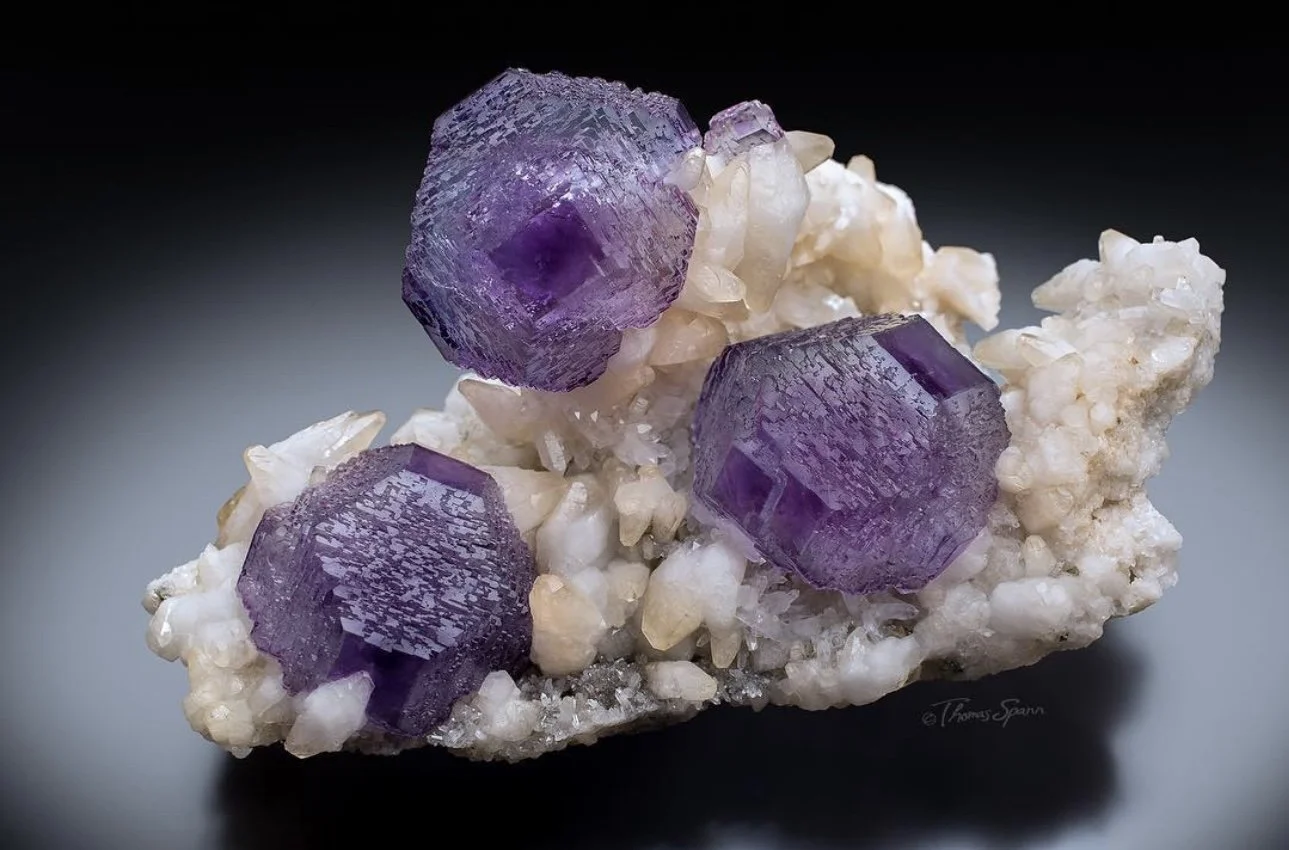
Fluorite on Calcite
During the late 1990s, long before Chinese minerals became widely recognized in the Western market, renowned mathematician Stephen Smale was quietly assembling one of the finest collections of contemporary Chinese specimens. Living in Hong Kong, he was uniquely positioned to acquire many of the most important discoveries directly from the source, often securing the finest examples before they reached Western dealers. This specimen remained in Smale’s personal collection for nearly two decades before its release.
Fluorite from the Shangbao Mine is immediately recognizable for its distinctive cubo-octahedral morphology, where stepped growth creates a complex geometric form unlike fluorite from virtually any other locality. This example stands among the finest of its size. Spanning more than eight inches across, it presents a series of perfectly isolated fluorite crystals gracefully suspended on a contrasting cream-colored calcite matrix.
The fluorite displays a rich lavender color accented by subtle sky-blue zoning, combined with exceptional luster. Its stepped faces interact beautifully with light, producing a mesmerizing display of reflections that continually reveal the complexity of the crystal geometry. The combination of scale, color, luster, crystal isolation, and Smale provenance makes this an extraordinary example of the Shangbao Mine and a particularly compelling representation of one of China’s most iconic mineral discoveries.